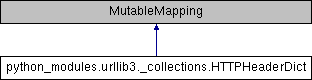
Inheritance diagram for python_modules.urllib3._collections.HTTPHeaderDict:
Public Member Functions | |
| def | __init__ (self, headers=None, kwargs) |
| def | __setitem__ (self, key, val) |
| def | __getitem__ (self, key) |
| def | __delitem__ (self, key) |
| def | __contains__ (self, key) |
| def | __eq__ (self, other) |
| def | __ne__ (self, other) |
| def | __len__ (self) |
| def | __iter__ (self) |
| def | pop (self, key, default=__marker) |
| def | discard (self, key) |
| def | add (self, key, val) |
| def | extend (self, args, kwargs) |
| def | getlist (self, key) |
| def | __repr__ (self) |
| def | copy (self) |
| def | iteritems (self) |
| def | itermerged (self) |
| def | items (self) |
| def | from_httplib (cls, message) |
Static Public Attributes | |
| iterkeys | |
| itervalues | |
| getheaders | |
| getallmatchingheaders | |
| iget | |
Detailed Description
:param headers:
    An iterable of field-value pairs. Must not contain multiple field names
    when compared case-insensitively.

:param kwargs:
    Additional field-value pairs to pass in to ``dict.update``.

A ``dict`` like container for storing HTTP Headers.

Field names are stored and compared case-insensitively in compliance with
RFC 7230. Iteration provides the first case-sensitive key seen for each
case-insensitive pair.

Using ``__setitem__`` syntax overwrites fields that compare equal
case-insensitively in order to maintain ``dict``'s api. For fields that
compare equal, instead create a new ``HTTPHeaderDict`` and use ``.add``
in a loop.

If multiple fields that are equal case-insensitively are passed to the
constructor or ``.update``, the behavior is undefined and some will be
lost.

>>> headers = HTTPHeaderDict()
>>> headers.add('Set-Cookie', 'foo=bar')
>>> headers.add('set-cookie', 'baz=quxx')
>>> headers['content-length'] = '7'
>>> headers['SET-cookie']
'foo=bar, baz=quxx'
>>> headers['Content-Length']
'7'
Member Function Documentation
§ add()
| def python_modules.urllib3._collections.HTTPHeaderDict.add | ( | self, | |
| key, | |||
| val | |||
| ) |
Adds a (name, value) pair, doesn't overwrite the value if it already
exists.

>>> headers = HTTPHeaderDict(foo='bar')
>>> headers.add('Foo', 'baz')
>>> headers['foo']
'bar, baz'
§ extend()
| def python_modules.urllib3._collections.HTTPHeaderDict.extend | ( | self, | |
| args, | |||
| kwargs | |||
| ) |
Generic import function for any type of header-like object.
Adapted version of MutableMapping.update in order to insert items
with self.add instead of self.__setitem__
§ from_httplib()
| def python_modules.urllib3._collections.HTTPHeaderDict.from_httplib | ( | cls, | |
| message | |||
| ) |
Read headers from a Python 2 httplib message object.
§ getlist()
| def python_modules.urllib3._collections.HTTPHeaderDict.getlist | ( | self, | |
| key | |||
| ) |
Returns a list of all the values for the named field. Returns an
empty list if the key doesn't exist.
§ iteritems()
| def python_modules.urllib3._collections.HTTPHeaderDict.iteritems | ( | self | ) |
Iterate over all header lines, including duplicate ones.
§ itermerged()
| def python_modules.urllib3._collections.HTTPHeaderDict.itermerged | ( | self | ) |
Iterate over all headers, merging duplicate ones together.
§ pop()
| def python_modules.urllib3._collections.HTTPHeaderDict.pop | ( | self, | |
| key, | |||
default = __marker |
|||
| ) |
D.pop(k[,d]) -> v, remove specified key and return the corresponding value.
  If key is not found, d is returned if given, otherwise KeyError is raised.
The documentation for this class was generated from the following file:
- python.d/python_modules/urllib3/_collections.py