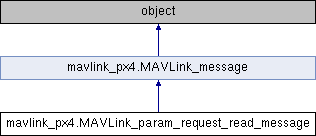
Inheritance diagram for mavlink_px4.MAVLink_param_request_read_message:
Public Member Functions | |
| def | __init__ (self, target_system, target_component, param_id, param_index) |
| def | pack (self, mav) |
 Public Member Functions inherited from
 Public Attributes | |
| target_system | |
| target_component | |
| param_id | |
| param_index | |
Detailed Description
Request to read the onboard parameter with the param_id string
id. Onboard parameters are stored as key[const char*] ->
value[float]. This allows to send a parameter to any other
component (such as the GCS) without the need of previous
knowledge of possible parameter names. Thus the same GCS can
store different parameters for different autopilots. See also
http://qgroundcontrol.org/parameter_interface for a full
documentation of QGroundControl and IMU code.
The documentation for this class was generated from the following file:
- Tools/mavlink_px4.py