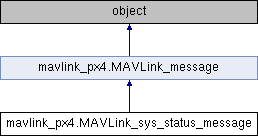
Inheritance diagram for mavlink_px4.MAVLink_sys_status_message:
 Public Member Functions inherited from
 Detailed Description
The general system state. If the system is following the
MAVLink standard, the system state is mainly defined by three
orthogonal states/modes: The system mode, which is either
LOCKED (motors shut down and locked), MANUAL (system under RC
control), GUIDED (system with autonomous position control,
position setpoint controlled manually) or AUTO (system guided
by path/waypoint planner). The NAV_MODE defined the current
flight state: LIFTOFF (often an open-loop maneuver), LANDING,
WAYPOINTS or VECTOR. This represents the internal navigation
state machine. The system status shows wether the system is
currently active or not and if an emergency occured. During
the CRITICAL and EMERGENCY states the MAV is still considered
to be active, but should start emergency procedures
autonomously. After a failure occured it should first move
from active to critical to allow manual intervention and then
move to emergency after a certain timeout.
The documentation for this class was generated from the following file:
- Tools/mavlink_px4.py